Dating in the age of algorithms
If someone you’ve just started talking to adds you to their “Close Friends” on Instagram, does it mean you’re becoming emotionally important to them? Or does it simply mean they’re comfortable letting you see the unfiltered or extremely curated parts of their digital life? This small, easily overlooked moment captures the larger confusion in modern online dating: we increasingly read emotional meaning into platform-mediated gestures that were never designed to carry the weight we assign them. Local dating apps that are swipe based have also turned dating into a series of signals that feel more meaningful than they are.
Dating today is not merely a social practice, especially on local dating apps that are swipe based, it is an interface experience. Algorithms decide which faces appear on our screens, which messages surface first, and which profiles feel “meant” for us. Over time, these quiet design choices reshape how people imagine chemistry, availability, and even commitment. Algorithmic environments are subtly rewriting the mental models people use to understand attraction, closeness, and relationship progression. Local dating apps subtly train users to equate visibility with importance.
When closeness is inferred from signals that were never meant to carry meaning:
Digital platforms compress multiple forms of closeness into identical gestures: viewing a story, reacting with an emoji, being included in a private content circle. These signals are easy to misread because they mimic intimacy without requiring it. Psychological research on parasocial interaction shows that people can feel emotionally connected to others through mediated exposure even when no reciprocal emotional bond exists [1]. In dating contexts, this dynamic plays out between two real people, but the asymmetry remains: one person may experience digital access as emotional proximity, while the other experiences it as casual visibility.
This mismatch is intensified by algorithmic ranking systems. Content is typically surfaced based on engagement likelihood rather than relational intent. When someone appears frequently in your feed, repeated visibility can begin to feel like emotional presence. Over time, familiarity becomes mistaken for closeness. The mere exposure effect, where repeated exposure increases liking, helps explain why algorithmic visibility can feel emotionally charged [2]. The platform teaches the nervous system to equate “seen often” with “important,” even when the exposure is mechanically produced.
The cost of this misinterpretation is subtle erosion of emotional clarity. Instead of asking direct questions, what does this connection mean to you? Where are we headed? People read the interface. Dating becomes an act of decoding metrics rather than negotiating meaning. Local dating apps that are swipe based often blur the boundary between attention and affection.
The Readiness Paradox: Aspirational love and the performance of unreadiness
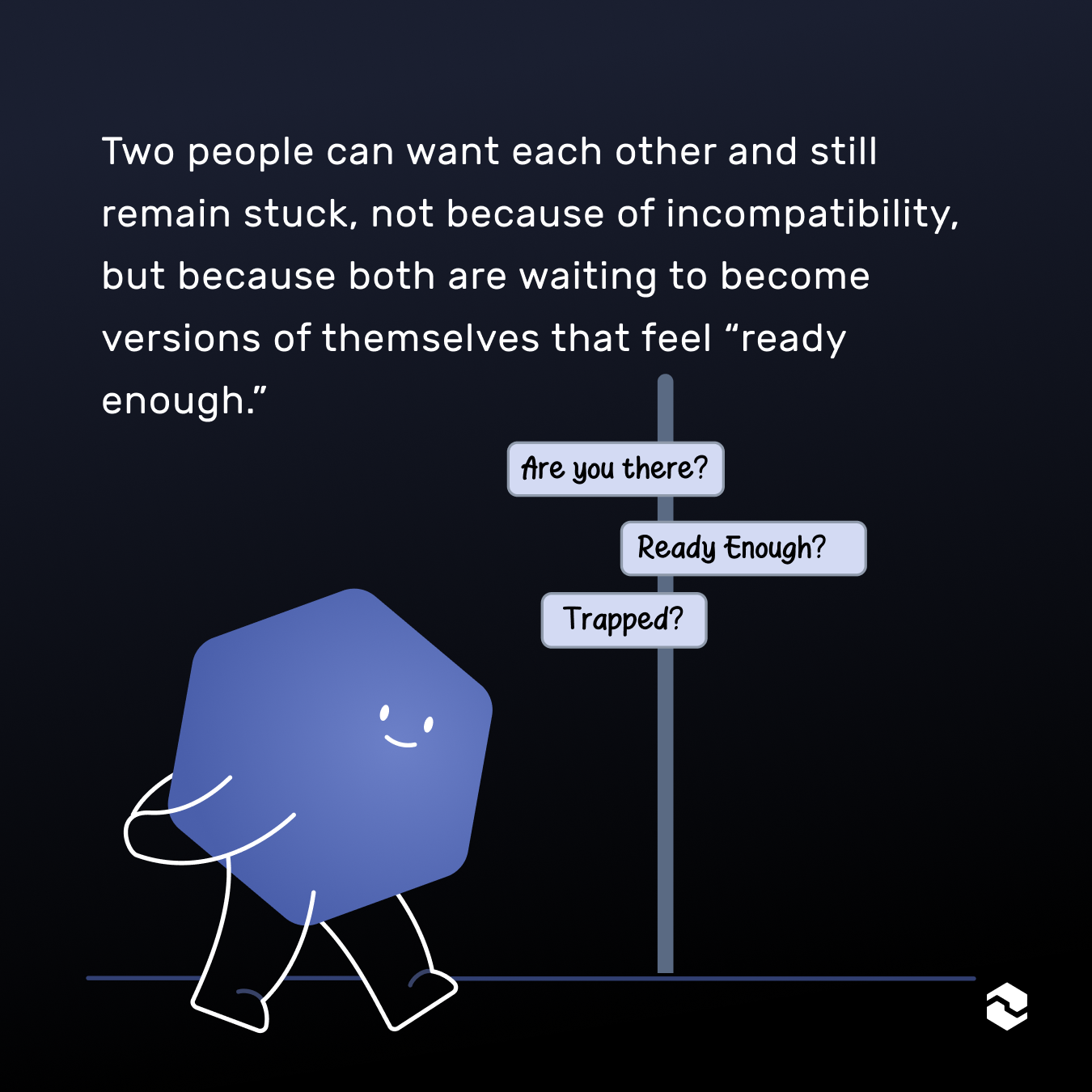
Recent data from Match Group captures a contradiction at the heart of Gen Z romance. A Harris Poll of 2,500 U.S. adults found that close to 80% of Gen Z believe lasting love is in their future. At the same time, only 55% say they feel ready for a relationship right now [3]. Hope exists, readiness does not. The result is a generation emotionally oriented toward commitment but behaviorally stalled.
The definition of “ready” has quietly expanded. Emotional work, self-knowledge, therapy, and firm boundaries are increasingly treated as entry requirements rather than ongoing processes [3]. This raises the bar for participation in relationships and delays commitment. Ironically, the longer intimacy is postponed, the more emotionally distant the dating environment becomes.
This hesitation also shapes how relationships appear online. The idea of publicly declaring a relationship, the so-called “hard launch”, feels like a reputational risk. Breakups no longer happen privately; they unfold in public memory. As a result, Gen Z prefers softer forms of visibility: suggestive posts, implied partners, curated ambiguity [3].
What looks like emotional unavailability may, in many cases, be emotional self-doubt. Two people can be mutually interested yet immobilised by their own sense of unreadiness. The match is made by software; the hesitation comes from within.
How location-based matching creates illusions of compatibility
Location-based matching systems don’t simply help people find each other, they shape how coincidence is interpreted. Local dating apps make geographic proximity feel like emotional alignment. When proximity becomes a sorting signal, urban overlap starts to feel meaningful. Research on mediated communication shows that repeated digital exposure increases perceived affinity, even when no substantive compatibility exists [4]. In cities like Bangalore , particularly on dating apps in bangalore where social life clusters around predictable neighborhoods and venues, algorithmic proximity can be mistaken for emotional alignment.
Environmental psychology research suggests that people often attribute emotional significance to spatial familiarity, especially when digital systems repeatedly highlight the same locations and faces [5]. Across dating apps in Bangalore, shared spaces often take on emotional meaning prematurely.The brain encodes familiar environments through spatial memory systems [6], which may intensify the subjective significance of repeated digital location cues. Over time, location cues begin to stand in for compatibility, producing a subtle illusion of inevitability.Through local dating apps , repeated encounters can feel like fate rather than filtering.This pattern is increasingly visible across dating apps in Bangalore , where proximity often feels like compatibility.
This spatial priming delays emotional clarity. When proximity is continuously framed as opportunity, the urgency to define intentions weakens. Critics argue that many platform architectures are structured around maximising engagement and retention, which can unintentionally reinforce ambiguity [7]. The result is a loop where access is mistaken for meaning. (For a deeper dive into dopamine reward loops and swipe behaviour, check out our previous article )
Emoji escalation and the new currency of micro-commitment
Somewhere along the way, emojis stopped being decoration and started acting like emotional signals. A single heart emoji can feel heavier than a paragraph. A puppy eye emoji can read like vulnerability. A thumbs-up emoji can feel like rejection. This isn’t people being dramatic, it's how meaning forms when most of your early-stage connection happens through screens. Research on computer-mediated communication shows that when tone, body language, and timing cues are stripped away, people lean harder on small symbolic signals to infer intent and emotional availability [4].
Over time, these symbols begin to function like a ladder of micro-commitments. Responding with warmth feels like emotional investment. Escalating emojis feels like progress. Pulling back feels like withdrawal. Studies on digital body language show that people now interpret punctuation, emoji choice, and response timing as emotional cues, even though none of these were designed to carry relational weight [8]. When someone adds you to close friends or reacts consistently to your stories, it can feel like being “chosen,” even if the other person experiences it as casual comfort rather than commitment.
The brain plays along. Neuroscience research on reward learning suggests that intermittent reinforcement, unpredictable responses, sudden bursts of attention and inconsistent warmth strengthen emotional attachment more than stable interaction [9]. Emojis, reactions, and small gestures become tiny dopamine hits. You’re not just reading meaning into them; your nervous system is learning to crave them. Digital interactions that feel unpredictable can therefore become especially compelling. This is why situationships feel so sticky. They drip-feed affirmation without requiring clarity.
Platforms quietly encourage this emotional ambiguity. Interface design research shows that features like reactions, “seen” receipts, typing indicators, and story views are engineered to create low-effort feedback loops that keep users emotionally engaged without pushing them toward resolution [10]. You stay invested without ever being forced to define the relationship. The system rewards ongoing signal exchange, not closure.
This is why modern daters are now craving clearer emotional codes. The rise of intentional dating language isn’t random, it’s the manifestation of fatigue. After years of decoding hearts, half-sentences, and story reactions, people are realising that symbolic intimacy is not the same as relational safety. Emojis can hint at feeling. They can’t carry responsibility.
When touch disappeared: How screens, algorithms, and COVID rewired modern intimacy
The human attachment system evolved for touch, proximity, and embodied co-regulation. Physical contact regulates stress physiology by lowering cortisol and activating oxytocin pathways that strengthen trust and bonding [11]. When relationships unfold primarily through screens, that sensory feedback loop is disrupted. Digital communication carries language and symbols, but it cannot replicate the neurobiological impact of sensory cues that stabilise emotional states [12].
During COVID-19 lockdowns, this disruption became structural rather than temporary. Studies examining romantic relationships during the pandemic reported heightened loneliness, increased relational uncertainty, and greater reliance on mediated communication [13]. While video calls and messaging preserved connection, they also amplified ambiguity. Without haptic (touch) reinforcement, partners relied more heavily on inference, tone shifts, response timing, word choice, placing greater cognitive load on emotional interpretation [14]. The absence of touch did not merely reduce warmth; it altered how the brain assessed relational security.
When the pandemic hit, dating didn’t stop, it moved almost entirely online. With travel restricted and social life paused, digital platforms weren’t just helpful tools; they became the main way people formed and sustained romantic connections. Conversations deepened quickly. People shared fears, dreams, and vulnerabilities over screens because there was nowhere else for intimacy to go.
Research on computer-mediated communication shows that when relationships unfold under physical constraints, emotional disclosure can accelerate [15]. You talk more. You imagine more. You fill in gaps. But that speed often comes with idealisation. Without body language, shared environments, or touch, the mind quietly completes the picture. The person on the screen becomes slightly smoother, slightly more aligned, slightly easier than reality.
And when people finally met in person, those imagined layers sometimes cracked. The chemistry felt different. The rhythm shifted. The version built through text and video didn’t always map onto embodied presence.
Modern love isn’t just shaped by feelings anymore. It’s shaped by the environments through which those feelings are filtered. The platforms we use were designed to maximise engagement, not clarity. They reward responsiveness, visibility, and repetition. They amplify small signals. They blur the line between access and intimacy. And because the human brain is wired to detect patterns, seek closeness, and respond to intermittent reward, we adapt to those systems faster than we realise.
If we mistake visibility for vulnerability, frequency for commitment, or digital proximity for compatibility, we risk outsourcing emotional meaning to software logic. Local dating apps organise exposure, but meaning still has to be negotiated offline.But when we recognise that algorithms organise exposure, not intention, we can begin reclaiming interpretation.
References :
[1] Horton, D., & Wohl, R. R. (1956). Mass communication and parasocial interaction . Psychiatry, 19(3), 215–229.
[2] Zajonc, R. B. (1968). Attitudinal effects of mere exposure . Journal of Personality and Social Psychology, 9(2), 1–27.
[3] Global Dating Insights. (2026, January 21). Match Group: Gen Z “Readiness Paradox” Reshapes Dating App Use .
[4] Walther, J. B. (1996). Computer-mediated communication: Impersonal, interpersonal, and hyperpersonal interaction . Communication Research, 23(1), 3–43.
[5] Scannell, L., & Gifford, R. (2010). Defining place attachment: A tripartite organizing framework . Journal of Environmental Psychology, 30(1), 1–10.
[6] Epstein, R. A., & Vass, L. K. (2014). Neural systems for landmark-based wayfinding in humans . Philosophical Transactions of the Royal Society B, 369(1635), 20120533.
[7] Zuboff, S. (2019). The Age of Surveillance Capitalism . PublicAffairs.
[8] Huh, E. (2025). The impact of emojis on perceived responsiveness and relationship satisfaction in text messaging . PLOS ONE
[9] Schultz, W. (2016). Dopamine reward prediction error coding . Dialogues in Clinical Neuroscience, 18(1), 23–32.
[10] Alter, A. (2017). Irresistible: The rise of addictive technology and the business of keeping us hooked . Penguin Press.
[11] Field, T. (2010). Touch for socioemotional and physical well-being: A review . Developmental Review, 30 (4), 367–383.
[12] Dunbar, R. I. M. (2018). The anatomy of friendship . Trends in Cognitive Sciences, 22 (1), 32–51.
[13] Luetke M et al. Romantic relationship conflict due to the COVID-19 pandemic and changes in intimate and sexual behaviors in a nationally representative sample of American adults . Journal of Sex & Marital Therapy. 2020 Sep 3;46(8):747–62.
[14] Baym, N. K. (2010). Personal connections in the digital age. Polity Press.
[15] Jiang, L. C., & Hancock, J. T. (2013). Absence makes the communication grow fonder . Journal of Communication, 63 (3), 556–577.
About the author:
Sharvani is a bioinformatics graduate and neuroscience enthusiast passionate about understanding behavior, emotion, and connection. She enjoys exploring how science and technology influence modern relationships. In her free time, she loves watching films and reading. Connect with her on LinkedIn
Dating in the age of algorithms
If someone you’ve just started talking to adds you to their “Close Friends” on Instagram, does it mean you’re becoming emotionally important to them? Or does it simply mean they’re comfortable letting you see the unfiltered or extremely curated parts of their digital life? This small, easily overlooked moment captures the larger confusion in modern online dating: we increasingly read emotional meaning into platform-mediated gestures that were never designed to carry the weight we assign them. Local dating apps that are swipe based have also turned dating into a series of signals that feel more meaningful than they are.
Dating today is not merely a social practice, especially on local dating apps that are swipe based, it is an interface experience. Algorithms decide which faces appear on our screens, which messages surface first, and which profiles feel “meant” for us. Over time, these quiet design choices reshape how people imagine chemistry, availability, and even commitment. Algorithmic environments are subtly rewriting the mental models people use to understand attraction, closeness, and relationship progression. Local dating apps subtly train users to equate visibility with importance.
When closeness is inferred from signals that were never meant to carry meaning:
Digital platforms compress multiple forms of closeness into identical gestures: viewing a story, reacting with an emoji, being included in a private content circle. These signals are easy to misread because they mimic intimacy without requiring it. Psychological research on parasocial interaction shows that people can feel emotionally connected to others through mediated exposure even when no reciprocal emotional bond exists [1]. In dating contexts, this dynamic plays out between two real people, but the asymmetry remains: one person may experience digital access as emotional proximity, while the other experiences it as casual visibility.
This mismatch is intensified by algorithmic ranking systems. Content is typically surfaced based on engagement likelihood rather than relational intent. When someone appears frequently in your feed, repeated visibility can begin to feel like emotional presence. Over time, familiarity becomes mistaken for closeness. The mere exposure effect, where repeated exposure increases liking, helps explain why algorithmic visibility can feel emotionally charged [2]. The platform teaches the nervous system to equate “seen often” with “important,” even when the exposure is mechanically produced.
The cost of this misinterpretation is subtle erosion of emotional clarity. Instead of asking direct questions, what does this connection mean to you? Where are we headed? People read the interface. Dating becomes an act of decoding metrics rather than negotiating meaning. Local dating apps that are swipe based often blur the boundary between attention and affection.
The Readiness Paradox: Aspirational love and the performance of unreadiness
Recent data from Match Group captures a contradiction at the heart of Gen Z romance. A Harris Poll of 2,500 U.S. adults found that close to 80% of Gen Z believe lasting love is in their future. At the same time, only 55% say they feel ready for a relationship right now [3]. Hope exists, readiness does not. The result is a generation emotionally oriented toward commitment but behaviorally stalled.
The definition of “ready” has quietly expanded. Emotional work, self-knowledge, therapy, and firm boundaries are increasingly treated as entry requirements rather than ongoing processes [3]. This raises the bar for participation in relationships and delays commitment. Ironically, the longer intimacy is postponed, the more emotionally distant the dating environment becomes.
This hesitation also shapes how relationships appear online. The idea of publicly declaring a relationship, the so-called “hard launch”, feels like a reputational risk. Breakups no longer happen privately; they unfold in public memory. As a result, Gen Z prefers softer forms of visibility: suggestive posts, implied partners, curated ambiguity [3].
What looks like emotional unavailability may, in many cases, be emotional self-doubt. Two people can be mutually interested yet immobilised by their own sense of unreadiness. The match is made by software; the hesitation comes from within.
How location-based matching creates illusions of compatibility
Location-based matching systems don’t simply help people find each other, they shape how coincidence is interpreted. Local dating apps make geographic proximity feel like emotional alignment. When proximity becomes a sorting signal, urban overlap starts to feel meaningful. Research on mediated communication shows that repeated digital exposure increases perceived affinity, even when no substantive compatibility exists [4]. In cities like Bangalore , particularly on dating apps in bangalore where social life clusters around predictable neighborhoods and venues, algorithmic proximity can be mistaken for emotional alignment.
Environmental psychology research suggests that people often attribute emotional significance to spatial familiarity, especially when digital systems repeatedly highlight the same locations and faces [5]. Across dating apps in Bangalore, shared spaces often take on emotional meaning prematurely.The brain encodes familiar environments through spatial memory systems [6], which may intensify the subjective significance of repeated digital location cues. Over time, location cues begin to stand in for compatibility, producing a subtle illusion of inevitability.Through local dating apps , repeated encounters can feel like fate rather than filtering.This pattern is increasingly visible across dating apps in Bangalore , where proximity often feels like compatibility.
This spatial priming delays emotional clarity. When proximity is continuously framed as opportunity, the urgency to define intentions weakens. Critics argue that many platform architectures are structured around maximising engagement and retention, which can unintentionally reinforce ambiguity [7]. The result is a loop where access is mistaken for meaning. (For a deeper dive into dopamine reward loops and swipe behaviour, check out our previous article )
Emoji escalation and the new currency of micro-commitment
Somewhere along the way, emojis stopped being decoration and started acting like emotional signals. A single heart emoji can feel heavier than a paragraph. A puppy eye emoji can read like vulnerability. A thumbs-up emoji can feel like rejection. This isn’t people being dramatic, it's how meaning forms when most of your early-stage connection happens through screens. Research on computer-mediated communication shows that when tone, body language, and timing cues are stripped away, people lean harder on small symbolic signals to infer intent and emotional availability [4].
Over time, these symbols begin to function like a ladder of micro-commitments. Responding with warmth feels like emotional investment. Escalating emojis feels like progress. Pulling back feels like withdrawal. Studies on digital body language show that people now interpret punctuation, emoji choice, and response timing as emotional cues, even though none of these were designed to carry relational weight [8]. When someone adds you to close friends or reacts consistently to your stories, it can feel like being “chosen,” even if the other person experiences it as casual comfort rather than commitment.
The brain plays along. Neuroscience research on reward learning suggests that intermittent reinforcement, unpredictable responses, sudden bursts of attention and inconsistent warmth strengthen emotional attachment more than stable interaction [9]. Emojis, reactions, and small gestures become tiny dopamine hits. You’re not just reading meaning into them; your nervous system is learning to crave them. Digital interactions that feel unpredictable can therefore become especially compelling. This is why situationships feel so sticky. They drip-feed affirmation without requiring clarity.
Platforms quietly encourage this emotional ambiguity. Interface design research shows that features like reactions, “seen” receipts, typing indicators, and story views are engineered to create low-effort feedback loops that keep users emotionally engaged without pushing them toward resolution [10]. You stay invested without ever being forced to define the relationship. The system rewards ongoing signal exchange, not closure.
This is why modern daters are now craving clearer emotional codes. The rise of intentional dating language isn’t random, it’s the manifestation of fatigue. After years of decoding hearts, half-sentences, and story reactions, people are realising that symbolic intimacy is not the same as relational safety. Emojis can hint at feeling. They can’t carry responsibility.
When touch disappeared: How screens, algorithms, and COVID rewired modern intimacy
The human attachment system evolved for touch, proximity, and embodied co-regulation. Physical contact regulates stress physiology by lowering cortisol and activating oxytocin pathways that strengthen trust and bonding [11]. When relationships unfold primarily through screens, that sensory feedback loop is disrupted. Digital communication carries language and symbols, but it cannot replicate the neurobiological impact of sensory cues that stabilise emotional states [12].
During COVID-19 lockdowns, this disruption became structural rather than temporary. Studies examining romantic relationships during the pandemic reported heightened loneliness, increased relational uncertainty, and greater reliance on mediated communication [13]. While video calls and messaging preserved connection, they also amplified ambiguity. Without haptic (touch) reinforcement, partners relied more heavily on inference, tone shifts, response timing, word choice, placing greater cognitive load on emotional interpretation [14]. The absence of touch did not merely reduce warmth; it altered how the brain assessed relational security.
When the pandemic hit, dating didn’t stop, it moved almost entirely online. With travel restricted and social life paused, digital platforms weren’t just helpful tools; they became the main way people formed and sustained romantic connections. Conversations deepened quickly. People shared fears, dreams, and vulnerabilities over screens because there was nowhere else for intimacy to go.
Research on computer-mediated communication shows that when relationships unfold under physical constraints, emotional disclosure can accelerate [15]. You talk more. You imagine more. You fill in gaps. But that speed often comes with idealisation. Without body language, shared environments, or touch, the mind quietly completes the picture. The person on the screen becomes slightly smoother, slightly more aligned, slightly easier than reality.
And when people finally met in person, those imagined layers sometimes cracked. The chemistry felt different. The rhythm shifted. The version built through text and video didn’t always map onto embodied presence.
Modern love isn’t just shaped by feelings anymore. It’s shaped by the environments through which those feelings are filtered. The platforms we use were designed to maximise engagement, not clarity. They reward responsiveness, visibility, and repetition. They amplify small signals. They blur the line between access and intimacy. And because the human brain is wired to detect patterns, seek closeness, and respond to intermittent reward, we adapt to those systems faster than we realise.
If we mistake visibility for vulnerability, frequency for commitment, or digital proximity for compatibility, we risk outsourcing emotional meaning to software logic. Local dating apps organise exposure, but meaning still has to be negotiated offline.But when we recognise that algorithms organise exposure, not intention, we can begin reclaiming interpretation.
References :
[1] Horton, D., & Wohl, R. R. (1956). Mass communication and parasocial interaction . Psychiatry, 19(3), 215–229.
[2] Zajonc, R. B. (1968). Attitudinal effects of mere exposure . Journal of Personality and Social Psychology, 9(2), 1–27.
[3] Global Dating Insights. (2026, January 21). Match Group: Gen Z “Readiness Paradox” Reshapes Dating App Use .
[4] Walther, J. B. (1996). Computer-mediated communication: Impersonal, interpersonal, and hyperpersonal interaction . Communication Research, 23(1), 3–43.
[5] Scannell, L., & Gifford, R. (2010). Defining place attachment: A tripartite organizing framework . Journal of Environmental Psychology, 30(1), 1–10.
[6] Epstein, R. A., & Vass, L. K. (2014). Neural systems for landmark-based wayfinding in humans . Philosophical Transactions of the Royal Society B, 369(1635), 20120533.
[7] Zuboff, S. (2019). The Age of Surveillance Capitalism . PublicAffairs.
[8] Huh, E. (2025). The impact of emojis on perceived responsiveness and relationship satisfaction in text messaging . PLOS ONE
[9] Schultz, W. (2016). Dopamine reward prediction error coding . Dialogues in Clinical Neuroscience, 18(1), 23–32.
[10] Alter, A. (2017). Irresistible: The rise of addictive technology and the business of keeping us hooked . Penguin Press.
[11] Field, T. (2010). Touch for socioemotional and physical well-being: A review . Developmental Review, 30 (4), 367–383.
[12] Dunbar, R. I. M. (2018). The anatomy of friendship . Trends in Cognitive Sciences, 22 (1), 32–51.
[13] Luetke M et al. Romantic relationship conflict due to the COVID-19 pandemic and changes in intimate and sexual behaviors in a nationally representative sample of American adults . Journal of Sex & Marital Therapy. 2020 Sep 3;46(8):747–62.
[14] Baym, N. K. (2010). Personal connections in the digital age. Polity Press.
[15] Jiang, L. C., & Hancock, J. T. (2013). Absence makes the communication grow fonder . Journal of Communication, 63 (3), 556–577.
About the author:
Sharvani is a bioinformatics graduate and neuroscience enthusiast passionate about understanding behavior, emotion, and connection. She enjoys exploring how science and technology influence modern relationships. In her free time, she loves watching films and reading. Connect with her on LinkedIn

Your privacy matters most.
- We will never share your data with any third parties. Vlncy will always be an ad-free platform.
- We will use your anonymised data only to improve the platform, in our efforts to serve you better.
- We do not store/ own any of your content on our servers.
- Upon account deletion, we will purge all your personal data.
- We will never reveal your identity on the platform. Only you decide when, how and with whom your information is shared.